Showing posts with label clean iron mend. Show all posts

Monday, 7 June 2021

Scarves: Wash, Iron, Mend

Necessary

I was out for dinner last weekend and had chosen to accessorize with a black, yellow, and white scarf. My scarf had twisted and so I gave it a tug and noticed a stain. Embarrassed, I excused myself and, in front of the powder room mirror, tried to position the stain so it would not show. Of course, the lightweight silk curled and curved the stain right back into its full frontal position. I finally tied a knot at the point of the stain and managed to get through the evening with a different look than what I had originally planned. The stain was hidden and that was more important.


This scenario motivated me to go to my closet and do a stain analysis of my scarves. My winter scarves, mittens, gloves, and neck warmers were all in good condition since I washed everything that was worn over the winter as soon as the spring sun started shining. 


Embarrassment revelation number 2: I could not remember the last time 
I had washed most of my accessorizing scarves. They appeared "clean enough" especially the patterned ones or ones that had no white or pale colours in the pattern. Nonetheless, I gathered them all up, took out my Forever New laundry soap for delicate fabrics, filled the fabric softener dispenser with vinegar and lavender oil, set the machine to delicate wash/gentle spin and set up my ironing board. 


I washed everything, the ones I barely wear along with my favourites. I didn't realize how many scarves I had. They are all now stain-free, ironed, and colour-organized. I need a tool, sort of like a fish counter, for every scarf so that I give them a timely wash. Make-up, natural skin oils, moisturizers, sunscreen, and hairspray all conspire to hold grime and so I'm setting up a routine to wash them, whether they are showing any errant stains or not. I don't think we need to wash accessorizing scarves after each wear as we do with cotton face masks or underwear but they certainly need to be washed more often than I had been previously doing. Jewellery is another accessory that we forget about cleaning, but I've dealt with that in older posts.

Doing this inventory was a good thing, I found one scarf with the hem ravelling and I found several that will be put into the "donate" bin. I don't know about you, but it does feel good to have a "clean slate".

I was inspired to attend to a summer set-up and re-organization of my closet. I colour-coded everything so that I can look at one section and have all my options available. And now my scarves are all organized in the same way providing even more options. Yay!


Buy my Guided Journal 

A Box a Day: A 30 Day Journal to Triumph Over Clutter 

Your Personal De-Cluttering Guide


Wednesday, 14 April 2021

Seasonal Closet Changes

Photo Source: Dan Gold on Unsplash
Seasonal clothing transitions from winter to spring require washing, mending, repairing, and storing winter clothing, boots and accessories; and w
ashing, mending, repairing and preparing clothing for spring and summer (because you didn't do it when you packed your summer things away). Overwhelming is a good word.

I'm a big proponent of small steps. I chose to do all my sweaters over a week because I wanted to wash them by hand. When they were dry I rolled them and put them in drawers in a spare bedroom. All the scarves, mittens and gloves were taken from the front entry closet and placed in one of the drawers in that same chest. Pick a category of clothing and commit to getting all of it put away and soon you will have gathered up and organized your summer clothing while putting away your winter things.

Cleaning: 
Make sure they're clean. This may mean handwashing wool and cashmere sweaters, scarves, and mittens; drycleaning wool suits and blazers, and cleaning and polishing boots. 

Mending & Repairing: 
There's no sense in putting something in storage and then taking it out the next season and finding it's unwearable. Mend it and if it's unrepairable, discard it. If you can't wear it and it can't be mended, no one else is going to want it. Check the heels of your boots for wear and tear. Get them re-soled or re-heeled with new heel tips now so that they are ready to wear when winter comes.

Photo Source: Nathan Oakley on Unsplash
Storing: 
Depending upon your space, this can be tricky. Storage is often a problem and the luxury of having a spare bedroom with an empty closet isn't available to everyone. A friend who lives in a 500 square foot condo, stores her sweaters in a large suitcase. She tucks in two or three unscented dryer sheets that she sprinkles with lavender essential oil between the sweaters and keeps the suitcase under the bed. Vacuum storage garment bags work as well. These can also be piled on high, hard-to-reach shelves while waiting for the next season. "Storage" furniture that doubles as seating (ottomans and benches) is another option. 

What's your storage strategy for off-season clothing and footwear?


Buy my Guided Journal 

A Box a Day: A 30 Day Journal to Triumph Over Clutter 

Your Personal De-Cluttering Guide


Thursday, 29 January 2015

Fix It Up First, Then Wear It

Know the worst before you go out! 
- Elsie de Wolf

In other words, look in the mirror and pay attention to what you see - panty lines or saggy butts, muffin tops or oversized sloppiness, a button missing or a stain. Whether something is too tight or too big, only a full size mirror reflects the true image. If you tell me that you don't care what other people think - fine. What do you think of your own "look"?  Shrugging your shoulders and saying you don't care in this instance won't do. If you leave your place creating excuses in case someone points out the falling hem, then you do care and you should change into something else. It is better to be seen twice in the same immaculate item, then once in something shabby. It seems that the human psyche registers the negative more quickly and for some reason remembers it more profoundly. That negative whatever in your clothing ends up coming back to haunt you for the rest of the day.

NEED: If you have made any clothing or closet resolutions, bringing your clothing to functional and aesthetic flawlessness is the most important. See my January 21, 2015 post. Without even looking in my closet, I know that my black blazer is missing a button on the sleeve, my sheepskin jacket needs to be replaced - it is beyond fixing, the hem is sagging on my navy sheath dress, my black boots need polishing, there are two un-ironed shirts that have been hanging in my closet for the last month . . . OMG! 

Speaking of haunting me for the rest of the day, it's time to take some of my own advice . . . 


Wednesday, 21 January 2015

Luxury Found in an Organized Closet

NEED

Luxury is anything you don't need, right? I mean, you need food, water, clothing, shelter . . . but good wine, good food, beautiful interiors, nice clothes; those aren't necessities, they are luxuries - it's all luxury.
- Marc Jacobs

We need to surround ourselves with beautiful things to appreciate and nurture the beauty in the world. If your closets are a mess and you are annoyed because you can't find what you want without rifling through the entire length of your closet, your annoyance affects your mood and ultimately your attitude to life; at least life for that day. When you do finally find what you were looking for, you discover a stain or a missing button or a hem that has ravelled. Now, you are not only annoyed, you are angry. Your mood affects everything you continue doing and consequently everyone you meet. "I'm having a bad day," you proclaim, in hopes that you will be pardoned for any bad behaviour. 

There's something to be said about stopping and smelling the roses and straightening out your closet. Roses are beautiful, a luxury. Buy some and put them in full view on the first day that you decide to attack the closet and take time to go and take a whiff.

The first thing you should not do is take out everything in your closet and throw it on the bed. Please, do not do that. Approach the closet in tiny steps. Make organizing your closet, a week-long, or even a month-long project. If it's been a mess for awhile, what's another few days?

Here are some general recommendations that you can interpret in a way that makes you comfortable and productive.

1. Categorize. Pants together, sweaters, tops, dresses, shirts, skirts - don't worry about sub-categories yet, just get everything that is the same together. Once that is done, then you can separate into colours within the clothing type. 

2. Get rid of wire hangers. Buy several packages of hangers that are all the same. For some reason, the same white, blue or beige plastic or decorator hangers bring a cohesive backdrop to the closet.

3. Sort by Function & NeedNow that you have everything looking organized, it's time to sort into another sub-category - function. If you have not worn something for over a year, put it aside. One more set of sub-categories for the stuff you haven't worn - garbage, give away, re-sale via consignment or Kijiji. 

4. Clean & Fix. The last thing to do is - clean, iron and mend. Those clothes that you have set aside for re-sale need this attention before you truck them to the consignment shop or post them online. Again this is something that could take you the next month or have someone else do it. Drycleaners and seamstresses need your business too.

For those of you who have perfectly organized closets - bravo! However, for the others, depending on whether you assign an hour a day or an hour a week to this project, it will feel good just to get started. You'll get it done - one small step at a time. And the result is pure luxury translated into time and temperament. You definitely will appreciate the luxury a well-organized closet affords and smelling the roses becomes more of a pleasure.

I am going to make everything around me beautiful - that will be my life.
- Elsie de Wolf


Monday, 8 December 2014

Buy Nothing Saturdays During December

For those who might accuse me of being a "Scrooge" during the holiday season because of my Buy Nothing Saturdays proposal, in fact, I think I will be better prepared for the holiday season with Saturdays off from shopping.

December 6, 2014 was my first Buy Nothing Saturday in the month of December. What did I do, what was or was not accomplished and will I be able to maintain this through the month?

What did I do?

1. I had a long and leisurely breakfast. After all I had nowhere that I had to go or anyplace that I had to be.

2. I had gone grocery shopping on Friday and planned to make chicken soup from scratch. After breakfast I prepped the chicken and ingredients for the broth and let time and a slow simmer do its magic. By noon I had a delicious chicken vegetable soup that was not only healthy but also low fat.

3. I read.

4. I watched tv.

5. I read.

What was not accomplished?

I wanted to organize my winter closet. My plan was to take out items that needed mending, cleaning and put them in respective bins. I also wanted to pull out all clothing that might qualify for "holiday" dressing.

What were the consequences?

I revelled in the luxury of not having to be anywhere at any particular time. Surprisingly, I did not feel any pressure or sense of remorse that I did not get to "save" any money on the "only today" sales. With a more relaxed day, I now feel more organized for any holiday buying I need to do during the next couple of weeks.

Saturday, 25 January 2014

Getting Dressed for Work

Closet Analysis: The Night Before


It is January and just like last January when I took a part-time contract at a university, I have done the same at a community college and technical institute in 2014. It's the end of January and this blog has taken a backseat to the time I am putting into my planning, preparation and correcting. However, once again for 3 months I am resurrecting my "work" closet and once again I am overwhelmed with a change in my schedule. I changed clothing three times the first day and vowed that would not happen again. As a result I have a few suggestions to make getting ready for work stress free and easy.


Nice
Point your shoes in the right direction. That was the advice given to me many years ago when I asked a veteran teacher how she kept organized at home. Her first words dealt with clothing and her closet. When you come home from work, change into comfortable clothing to create a physical break with your workday.   Even if you are going out later, change and wear something else. Now choose what you are going to wear to work the next day. Check for secure buttons, working zippers and stains on clothing. Hang everything together (jewellery included), shoes placed pointing as if leaving your bedroom (this is definitely optional), and underwear (stockings or socks included) looped around the top of the hangar or in pockets. Voila! It's done, you have no potential clothing malfunctions and no clothing options to stress you out the next day when you are dressing for work.

I use a "valet" and because it is not physically in my closet, I am not tempted by other items I see hanging around my original choices. See my January 13th post, 2014 Casual: Separates and Flats.


Necessary
Take a closet inventory for defects. You must take inventory of loose buttons, split seams, undone topstitching and other such unsightly problems that make dressing a pain. The best way to deal with this is to make a closet date and assign a specific amount of time to attending to these necessary tasks. If nothing needs fixing, keep your closet date to iron, sort and organize, eliminate, substitute, combine, modify, put to other uses and rearrange.


Note-Worthy & Need
Take a closet inventory for needs. My 2014 resolution to dress up more comes from necessity and only because I accepted a temporary contract to teach. I need some separates to round out my work wardrobe and bring some life to trousers and blazers that have been in my closet for awhile or else I won't be wearing them. I have a dark purple skirted suit that needs a more colourful top than what I have previously worn with it. Armed with a closet need list for work and because what I need are basics, I will now watch for the sales that will be happening as we slowly move out of the winter season toward spring.


Friday, 27 December 2013

Shoes: To Fix or Not

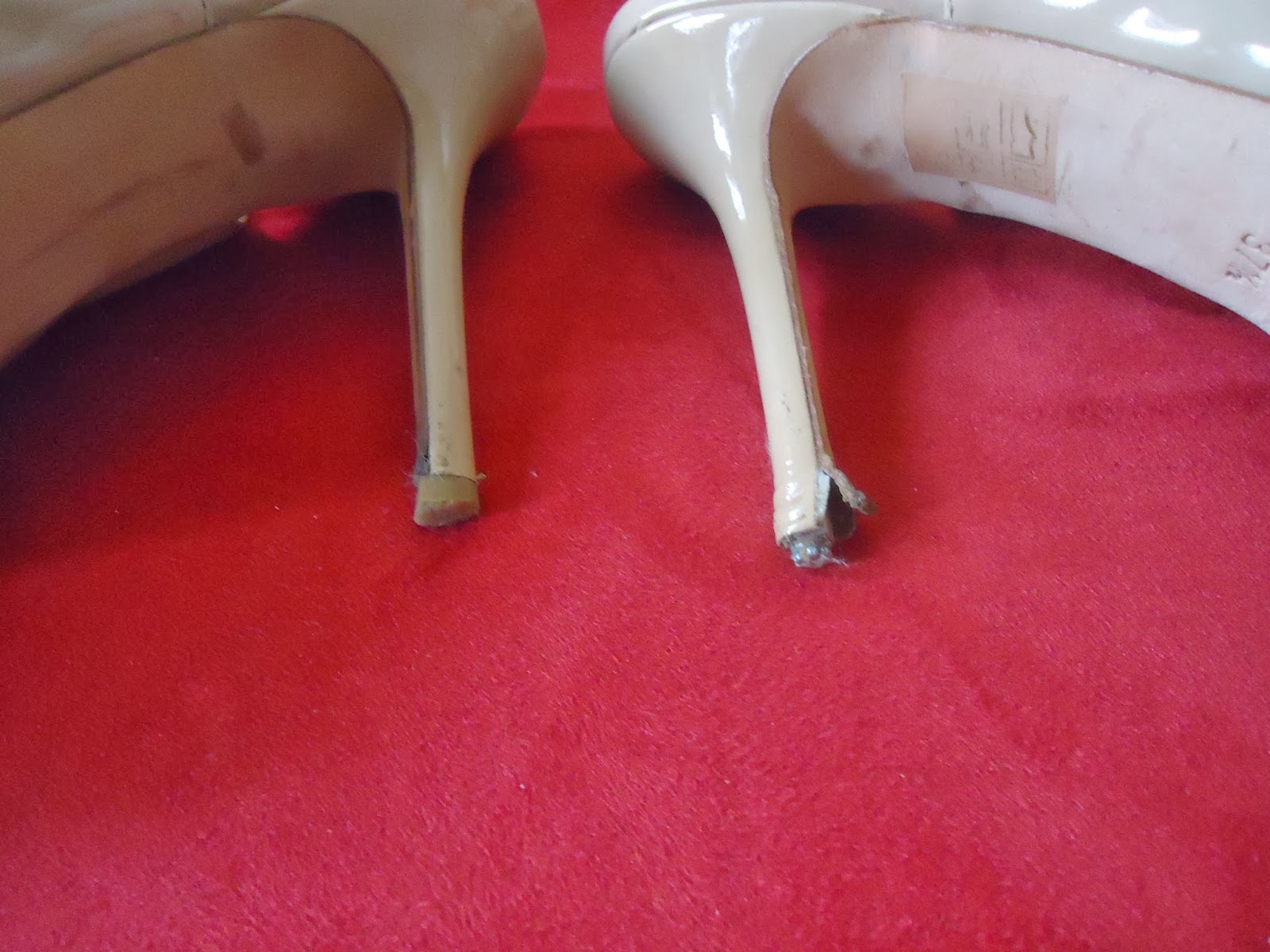
These Choos are NOT made for walking: The designer shoes that look old and tatty after one day's wear.
- Joanne Hegarty,  Mail Online, August 15, 2011

I certainly did NOT experience the extent of the problems that Joanne Hegarty and friends did in the article about the delicate nature of designer shoes but after an afternoon reception I did come away with damage that I personally did not even realize happened. 

Jimmy Choo heel tip. Photo by JoyD
The Jimmy Choos I bought in 2011 have served me well until I went to an outdoor wedding reception in Germany last summer. The heel tip was gone and I was walking on the metal "nail". The leather was pulled back on the heel and lifting from worse to slight almost halfway up the heel. I couldn't wear them and so I began searching to see if I could get them fixed. I emailed Jimmy Choo customer service and a person responded quickly and efficiently with a shoe repair reference in New York state. I was in France at the time and was returning to Canada. With that information, the Choo advisor suggested I take them back to where I bought them. When I came back to Canada, I explored both alternatives but needed some time to ponder whether the cost and effort would be worth it for a pair of shoes, already over two years old. With the information I collected, I came to the reality that I probably would just buy a new pair rather than pay return shipping and repair and heel replacement fees. At the very least my research revealed that they were fixable. I was talking about my dilemma to my friend Sharon over lunch and she suggested that I try a new local shoe repair service whose work is "fabulous"! 

This new "shoemaker" was from Romania and performed a small miracle for no more than the cost of a new pair of heel tips, less than $15.00 (Cdn). I was relieved, appreciative and certainly confident that she could repair just about anything I would take to her. 

Shoe Advice: 

No matter the brand name, the more delicate the shoe (such as a strappy sandal with a thin leather sole), the more necessary to have them re-soled before you actually wear them. You are not so much getting them re-soled but reinforcing the delicate leather sole with another leather sole. If you wait until after the original sole has worn, you may not be happy with a complete "re-soling" which may change the look in a more pronounced way than if you had them reinforced originally.

Black marks on light coloured patent can be removed with petroleum jelly and a little rubbing or if that doesn't work, non-acetone nail polish remover will remove the black marks if they are superficial and not "embedded".

Always use a protection spray on shoes and boots if there is the slightest chance that you will encounter moisture on leather soles. And when I write "moisture" I don't only mean a torrential downpour, I mean the dampness of a grassy lawn - those heels will sink and after a couple of hours of contact, the leather on the heel could very well lift and the heel tip compromised. Think of those heels soaking in wet soil for two hours. Walk on concrete steps after and the heel could encounter significant damage. Be careful and think twice before spending a lot of time on that lawn in heels - gardeners wear rubber clogs for a reason.

Going out for dinner is different than dancing all evening so choose different pairs for different purposes.

When encountering problems with designer shoes, return to the store where you bought them for advice, you will receive more specific pertinent information from the local retail outlet than the designer's website. For this reason, I will never buy designer shoes online but of course, that is a very personal choice.

Explore alternatives before throwing away a pair of shoes. You'd be surprised what a good cobbler can do!


Friday, 6 September 2013

Do Not Bleach!

Grey & white striped Armor Lux top. Photo by JoyD.
After Bleaching - grey is now pinky beige. Photo by JoyD


So what part of "do not bleach" did I not understand? I noticed a black smudge on my Amor-Lux grey and white striped long-sleeved top. I decided that I would use one of those bleach pens to just dab it lightly and if the grey bleached out white a bit, I could live with that. Trouble is the bleach turned the grey to a pinky beige colour. So then there was a pinky beige splotch on the grey and white stripes - actually worse that the black smudge that was there in the first place. So what did I do? Bleached the whole thing of course. Now instead of grey stripes, I have pinky beige stripes. I can live with that but I am annoyed with myself for not heeding the manufacturer's washing instructions.

Funny thing is, and it must be my personality type, I began looking for an explanation online after I created the problem instead of looking for a solution for the black smudge in the first place. I do like understanding why something happened.

So now after the fact I found out from Yahoo Answers that the fabric, when you use bleach, "won't turn white. It will only bring it back to the original fabric colour before . . . dyed grey in the factory". Is that a fact? I read about a guy who put bleach into his wash of grey sweats and they all came out pink. Now I know and so does he.

Now we know! Here are a few other things I already knew and a couple I learned about bleach, after the fact:
Bleach takes out stains from certain fabrics, it should not be used as a dye (for a lighter colour). 
If you are trying to get "white" by bleaching dark clothing, it probably won't happen. They will lighten but never become truly white. And of course, there's the other explanation of bleaching bringing fabric back to the original colour in the factory.
Always dilute bleach. Straight bleach can damage clothing. 
Wear gloves in a well ventilated area when working with bleach. 
As far as clothing goes, linen and cotton stand up best to bleaching. However, rayon and some polyesters also can stand up to bleach.
To work effectively, bleach needs to be mixed with warm or hot water. 
Never mix vinegar with bleach - the two create a toxic gas. Just click if you need the scientific explanation. 
Wool and silk are far too delicate to bleach. It may in fact weaken the fibers to the point of disintegration.
There are plenty of sites giving good advice when working with bleach. I'm old enough to have known better. Sigh. 

Saturday, 3 August 2013

Espadrilles

Closet Content Analysis: Summer Shoes

Choices: Espadrilles

Nice     Need     Necessary

NICE: A summer basic shoe in South-West France
White espadrilles with white linen trousers. Photo by JoyD, July, 2013.

La Classique or traditional espadrilles are worn by both men and women and although presently they may not be so popular, they are chic. Over the years, varying heights of wedge heels have been adapted for women but the debatable question would be, is it still an espadrille? My position would be no. In the same way for men, I have seen canvas loafers called espadrilles but essentially they are not espadrilles. The traditional loafer upper is quite different.

Several sources have identified Spain as the originating country but I was introduced to them in the Basque area of France, which of course adjoins the Basque area of Spain. And Basque is Basque with its own language irrespective of the national boundaries. Here espadrilles are a summer basic and there is no thought of "tendance" or trend. When I visit Arcachon, a seaside resort, I always buy myself a pair or two. Against my better judgement this year's purchase was a white pair.

In Arcachon or anywhere in the South-West, it is not a matter of in-fashion or out-of-fashion. In the same way as we in North America buy those cheap rubbery flip flops, the espadrille is a summer footwear option in Spain and France. Of course you can pay $5.00 for them or $500.00. These particular ones were made in France and cost me 18 Euro, about $24.25 Canadian; $25.05 Australian; $23.06 American and 15.48 British Pound Sterling.

NICE: Espadrilles are not so much a fashion item but a summer basic. Wearing an inexpensive pair, gives you the laissez-faire attitude required for hot summer days. Last week I was visiting in the south-east of France and saw a great pair of red espadrilles on a young woman. They were perfect for her foot, the heel fit well and did not look at all sloppy. In fact she looked rather polished and cool on a 40ish day in the Rhone.

NO THANKS: Many have abandoned wearing them because "they keep falling off my feet!" Bien sur. However this NO THANKS  can become an UN-NECESSARY. And of course the more expensive ones fit the heel better than the ones in the grocery store bins.


Espadrilles with "squashed heel". Photo by JoyD, France, 2013.
NECESSARY Evolution: The heel slips down off your foot, becomes smashed down, you continue walking on them, and essentially you now have a pair of quazi-flip-flops. In fact I like this look. Perhaps it further suggests the lay-back atmosphere of summer: "I can't be bothered to put on my shoes properly so I just slip into them and this is how it is." I have seen traditional ones, made in Spain and France, with laces or "ribbons" attached to the back of the heel so that you can wrap the ties around your ankles to keep the back from slipping down.


Striped Espadrilles in St. Emilion. Photo by JoyD.
All my guests want to visit St. Emilion when they are here. There is a shop where linens are sold that has become my favourite and I always stop by with my visitors and we often browse and buy while our partners go off buying wine. Not only does this shop have linens for the table, but also peignoir and espadrilles. How convenient and how perfect are these striped ones for €21.


Buying and Caring for Espadrilles

Visit Soludos for contemporary innovations of the espadrille.

One sales associate suggested to buy them really tight and they will loosen and mold around your foot. I received that information after buying a pair that was actually a size bigger than what I usually wear. I'll try that with the next pair I buy.

If they stretch out and are too big, someone online (I forgot to take the address down) advised to soak the top cotton upper in hot water - don't immerse the jute soles. I can't imagine doing this. You would have to hold them in that position for five minutes . . . hmm, I think I'll just wear them as "smashed down heel flip flops". I'm speculating that if the jute is secured with glue, it will come apart if they are submerged in water. I suppose it depends where they were made. The more traditionally made ones should stand up to a 5 minute soak. I don't think I am willing to take that chance. 

Thursday, 28 March 2013

Skinny Pants

Choices: Last season's sale items at Holt Renfrew vrs. Costco 

New (Purchased over the last 6 weeks)
Note-Worthy      No Thanks     Need    


I've purchased three pairs of skinny pants in the past six weeks; two were on sale at Holt Renfrew and one pair was a Costco purchase - each in three different Canadian cities. Skinny pants are my alternative to short shorts. As to weather considerations, a loose pair of linen pants or a gauzy lightweight dress/shift would be better in hot weather than short shorts anyway. It's an age thing.


Retrieved from Lyst on March 27, 2013.
The dark taupe Theory pair were purchased at Holt Renfrew in Edmonton, Alberta at the sale cost of $149.00 (plus 5% GST) at the beginning of February. The original cost was $225.00. Theory was founded in 1997 by Andrew Rosen in New-York but is now a Japanese owned company. Clothing from Theory has defined "the modern contemporary category". According to the publicity statements, "exceptional fit, high-quality fabrics, and sleek silhouettes for both men and women have made Theory designs go-to staples in stylish closets around the globe". The starting retail prices are about $200.00 for pants. My favourite way of wearing my dark taupe Theory pants through the last of the snow is with a pair of flat knee-high boots and a black lightweight merino wool top. For work I put a black blazer on and it feels perfect.


Retrieved from Hudson Jeans on March 27, 2013.
I paid $99.00 (plus British Columbia HST of 12%) for these Leeloo super skinny cropped Hudson "bone white" pair with black side stripe at Holt Renfrew in Vancouver. They were originally priced at $198.00 but I bought them for $99.00 on March 19th. On the Hudson website I found them at a sale price of $119.00. They look more white in this photo than the beige I see in real life.

Nice:  My favourite of the two are the Theory pair. They feel the best, they sit the best and the dark taupe is my new beige. 

Need: I intend to find a floral top or a striped scarf including a matching taupe accent to lighten and brighten the Theory skinny pants for spring, 2013.

Note-Worthy 1:  Even though the cropped Hudson pair don't fit or sit as well as the Theory pair and they feel like they are "falling down" (but of course I only found this out after wearing them for a day), I do like the look. As well because stripes are such a strong trend this spring, I still am glad I bought them. 

Need:  A belt to keep my Hudson Leeloo cropped pants up!

Note-Worthy 2:  I bought a beige pair of skinny pants for a Costco purchase of $24.99. Of all, these are the easiest to wear and certainly fall into that "comfortable casual" category since they have no front or side zippers, except to act as fake pocket closures, and are simply a pull-on. What's note-worthy is that when I wear any one of the three, the "look" is essentially the same. Alfred Sung is a Canadian designer who is responsible for the Club Monaco label (with Saul and Joe Mimran - of Joe Fresh fame).

What shoes to wear with skinny pants: 
Professional stylists tend to put heels with skinny pants and I have done that. In the winter, flat or heeled boots are so perfect but in the summer, the ballet flat is my preference.

Care for cotton based clothing with elasticine or polyesters: 
The Theory label suggests the need for drycleaning. Yet the content of the Theory pants are over 60% cotton with nylon and elasticine. Sticking that drycleaning label on their clothing is a default action to defray any liability for fabric destruction by customers. Essentially they don't trust us to know how to care and clean our clothing. For the most part, when it comes to pants, the only ones I dryclean are those that are 100% wool (or the majority percentage is wool) and could be described as "dress pants" or "suit pants" - professional pressing and cleaning is a combination I cannot duplicate for those pants. The Hudson pants are 90% cotton and the Alfred Sung Costco pants are polyester and elasticine. Their labels both suggest a delicate cold water machine wash with similar colours, hanging to dry or tumble dry and ironing with a low iron if needed. If your iron has a "synthetics" setting, that would be considered "low". The Alfred Sung pants appear not to need any ironing and I would modify the "ironing" to inside out on the Theory and Hudson pants. I just washed the Theory pants, nothing bad happened and they look fine.

One of the reasons I iron my pants inside out is to prevent that "shine" which occurs when your iron is too hot for the fabric composition. To be on the safe side, anything that has nylon, elasticine or spandex in it should be ironed inside out. My guess is that the nylon, etc. has a lower melting point and those fibres will melt and create the shine. I may be wrong but it's a thought. Some will suggest using an ironing cloth, a cotton or linen piece to place on the fabric you are ironing so that the iron does not touch the clothing item directly. Good use for an old linen shirt or cotton t-shirt.

Another inside out ironing tip is to iron the zipper area and the seams open flat (if they aren't stitched together that is). This provides a flat finished look rather than the crumple you sometimes see at the seams or zippers.